Posts Tagged ‘Sedona’

It was a hot fall day at the Amitabha Stupa

Tuesday, November 1st, 2011

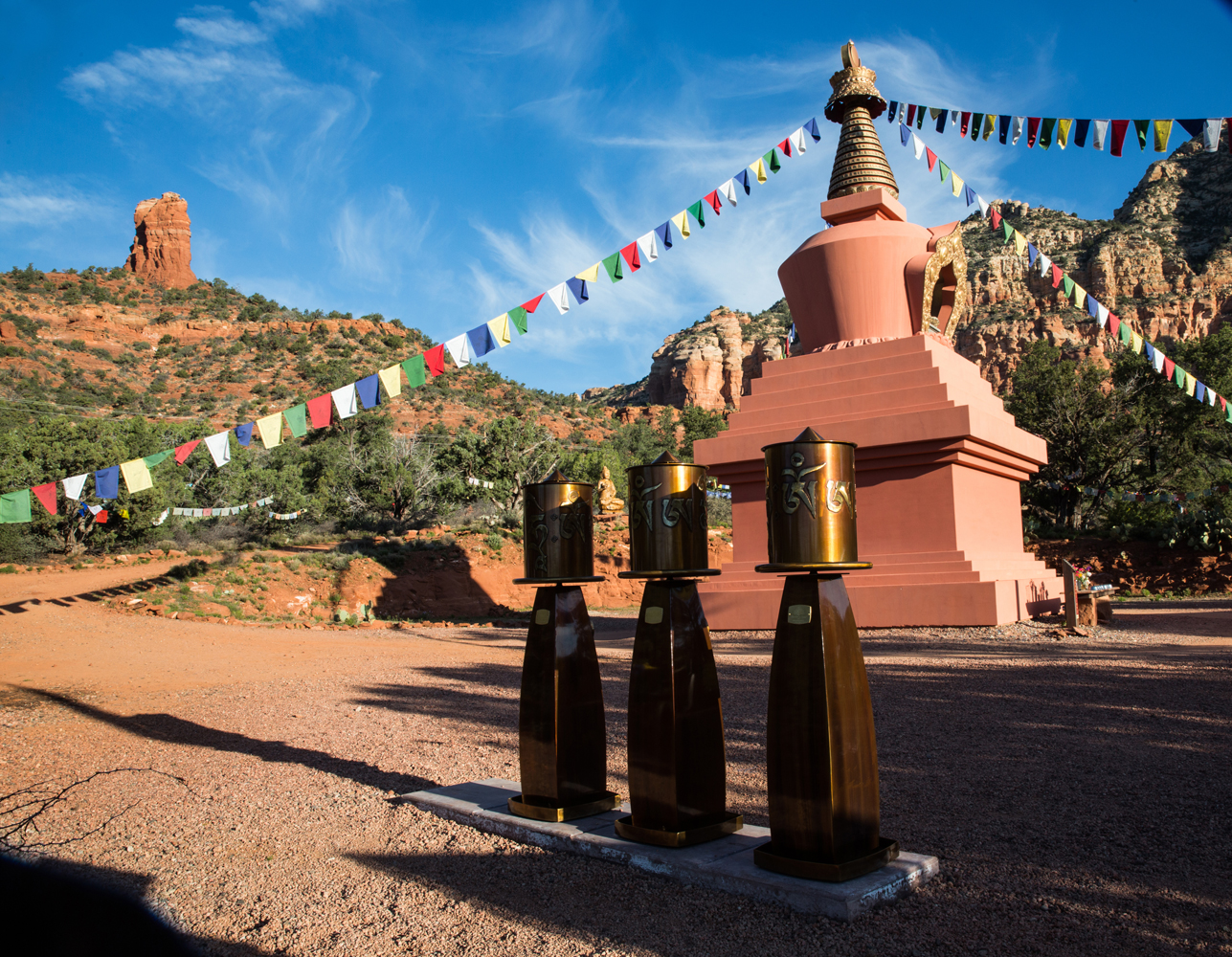
Amitabha StupaIt was a hot fall day at the Amitabha Stupa. The sun glinted off the tigle (teardrop) at the top. Golden wildflowers garlanded the clearing, and chirping birds filled the air, adding their own praises. One Colorado blue bird regularly nose dives for one of the water offering bowls to get a quick drink and then resumes his antics in a nearby pinion pine.

Nearly a dozen KPC members from Sedona gathered to practice the “Shower of Blessings,” a moving, devotional ceremony which, each Saturday afternoon (currently at 4 p.m.) and on ritual holy days, includes a food feast or tsog offering. Often visitors join the practice or share in the food feast at the end. Everyone is welcome.

During the middle of the ceremony, a Sri Lankan family came to the stupa to say some traditional prayers. They had made the trip from California especially for this purpose. After a few moments of silent prayer, the three visitors walked around with candles. They were unlit because of fire restrictions. Although initially disappointed, the family was reassured that imagining them ablaze is considered to be equally effective.  In the Buddhist tradition, visualizing an offering is as potent as making one.

Shower of Blessings TsogDuring the “Shower of Blessings,” visitors kept coming. Some hesitated to walk around the stupa at first, but were warmly greeted and told it is always appropriate to circumambulate a stupa, even if there is a ceremony in progress.

As the sun went behind the red rocks, more people came to meditate and pray. The cooler evenings always bring locals who come to the site to worship. By 6:30 the sun was gone, and the stupa park closed.

October 25 2011 at the Amitabha Stupa

Monday, October 31st, 2011

It is always surprising how much there is to experience in this absolutely still place.  Although the Amitabha Stupa and Peace Park is in the heart of West Sedona and readily accessible, it seems very much removed from daily life. The 14-acre parcel of land is studded with arroyos, pinions, junipers, brush and cacti, as well as abundant wild life that either live on the land or pass through—from quails and ravens to the occasional meandering coyote.  In the center of this bounty, stands the stupa.

242304053_o2oXi-S

With so much to see, it’s no wonder that hikers come through the land as well (one day last week there were two groups of 25 people in addition to many individual hikers), and tour guides often bring visitors to experience the extraordinary beauty and calm energy. The stupa has even been dubbed “an unofficial vortex” by Sedonans.

As spectacular as the scenery is, it is secondary to the spiritual refuge that this sacred land provides. People come from all over the world to connect with the power and goodness of the stupa, often leaving offerings of personal meaning in addition to contributions to the upkeep of the land in designated offering boxes. One day it might be conch shells, a rose quartz, a red toad with a quarter in its mouth, a friendship ring and an American Indian sage bundle. At another time it might be silk flowers, cylindrical metal chimes, a clear jar of blood-red heart stones, a ceramic egg, a wooden cross, a black and yellow toy car and a Buzz Lightyear figurine.

A few years ago someone left a song of peace, which ended with “Feel the wind of love increase, as we move this world to peace. Come love the world with me.” A few months ago, a grieving son and daughter left a carved bird for a father who just passed away (he had spent many hours on the land bird-watching); and the other day, a Japanese visitor left a letter to her half brother, whom she had never met. She assured him that “nothing is your fault. … You are an heir of love, remember that. … My prayers are with you.”

People of all spiritual traditions are drawn to the stupa. It is a place where one can feel safely at peace and where the mind can experience stillness, hope, inspiration and love. It is a place to keep one’s spirits up during difficult times and a place to pray for those who are suffering. During times of world crisis, many people are drawn to the stupa to pray. This movement of consciousness from the particular to the general comes naturally at the stupa where the mind seems to expand easily and embrace all of life.

633642315_j6eeN-S

Blessings of the Amitabha Stupa

Wednesday, August 26th, 2009

sd-3640145

The Amitabha Stupa in Sedona is a place of refuge and Buddhist practice.  A stupa, called a chorten in Tibetan, is a receptacle of offerings and represents the outward expression of the Buddha’s enlightened body, speech and mind. 

According to Tulku Sang Nang, an accomplished Vajrayana master and stupa builder who helped build and consecrate the Amitabha Stupa, “By seeing a stupa or hearing about a stupa, remembering it, visualizing it, whatever the case may be, any kind of connection will imbue you with a blessing, will connect you to enlightenment.  So, whether it is a bug or a human or animal without a body, you know, just floating through space, any being that come in contact with a stupa will be blessed and gain merit.”

Please enjoy the following slideshow of the sagadawa ceremony held at the Amitabha Stupa in June, 2009.

